i wanted to visitor visit my web design agency website through blog post what blog post i will write
To drive traffic to your web design agency, your blog posts need to do more than just look pretty—they need to solve a problem or answer a question for your ideal client.
Since most people hiring an agency are business owners or marketing managers, you should focus on topics that connect design to business growth.
1. Education & Strategy (The “Why”)
These posts establish you as an expert and help clients understand why they need to invest in professional design.
“7 Signs Your Website is Costing You Customers” (Focus on high bounce rates and outdated UI).
“UX vs. UI: What’s the Difference and Why Should You Care?” (Simplifying jargon for business owners).
“How a Website Redesign Can Increase Your Conversion Rate by X%” (Use data and psychology).
“Mobile-First Design: Why Your Desktop Site is No Longer the Priority.”
2. Industry-Specific Guides (The “Who”)
Niche down to attract specific high-value clients. If you speak their language, they are more likely to trust you.
“The Ultimate Guide to Web Design for Law Firms/Real Estate/E-commerce.”
“What Every SaaS Startup Needs on Their Homepage to Convert Visitors.”
“5 Must-Have Features for Modern Medical Practice Websites.”
3. SEO & Performance (The “How It Works”)
Business owners care about being found on Google. Show them you understand the technical side.
“Does Your Design Affect Your SEO? (Spoiler: Yes).”
“Why Page Speed is the Most Important Part of Your User Experience.”
“How to Optimize Your Images for the Web Without Losing Quality.”
4. Trust & Transparency (The “Who We Are”)
These posts help “warm up” a lead before they contact you.
“Our Process: What Happens After You Hire Us?” (Step-by-step look at your workflow).
“Case Study: How We Helped [Client Name] Double Their Online Leads.”
“Web Design Trends to Watch in 2026 (And Which Ones to Avoid).”
Comparison Table: Which Post Type Should You Write First?
| Goal | Best Post Topic | Traffic Source |
| Quick Leads | Industry-Specific Guides | LinkedIn / Cold Outreach |
| Long-term SEO | “How-to” & Technical Guides | Google Search |
| Brand Authority | Case Studies & Process | Social Media / Newsletters |
Pro-Tip for Traffic: “The Content Upgrade”
At the end of every blog post, include a Call to Action (CTA). Don’t just say “Hire us.” Instead, offer a freebie like a “Website Audit Checklist” or a “2026 Design Trend Report” in exchange for their email address.
Would you like me to help you outline a specific blog post from this list, or perhaps write a catchy headline for a specific industry you target?
what generally client look
When a client is looking for a web design agency, they aren’t just looking for “someone who makes websites.” They are looking for a business partner who can help them make more money, save time, or look more professional.
To win them over through your blog, you need to address these five specific things they are looking for:
1. Proof of Results (Social Proof)
Clients are scared of wasting money on a site that doesn’t work. They look for:
Case Studies: Not just screenshots, but stories of how you solved a problem (e.g., “Increased sales by 30%”).
Testimonials: Real words from happy business owners.
Industry Experience: “Do they understand my specific business (Real Estate, Medical, SaaS)?”
2. Business Value, Not Just Beauty
Most clients don’t care about the “code”—they care about the results. They look for:
Conversion Focus: Will this site turn visitors into leads?
SEO Knowledge: Will people actually find this site on Google?
Mobile Performance: Does it work perfectly on a phone? (Since most of their customers are on mobile).
3. A Clear & Professional Process
Clients hate “black boxes” where they pay money and don’t hear from the designer for weeks. They look for:
Transparency: What are the steps? (Discovery → Wireframe → Design → Launch).
Timelines: How long will it take?
Ownership: “Will I own the site when it’s done? Can I edit it myself later?”
4. Communication & Trust
Since a website build can take weeks or months, the client wants to know if you are easy to work with. They look for:
Responsiveness: How fast do you reply to emails?
Jargon-Free Language: Can you explain technical things in a way they understand?
Post-Launch Support: “What happens if the site breaks next month? Are you still there to help?”
5. Strategic Thinking
The best clients want an agency that pushes back and offers advice. They look for:
Advice: “Don’t just do what I say; tell me what is best for my business.”
Modern Trends: Are you using the latest tech (AI integrations, fast loading speeds, accessibility) or are you stuck in 2018?
How to use this for your Blog:
Instead of writing “Why you need a website,” write posts that answer these hidden concerns.
To address #1: Write: “How We Rebuilt [Company X]’s Site and Doubled Their Leads in 3 Months.”
To address #3: Write: “What to Expect: Our 5-Step Process for a Stress-Free Website Launch.”
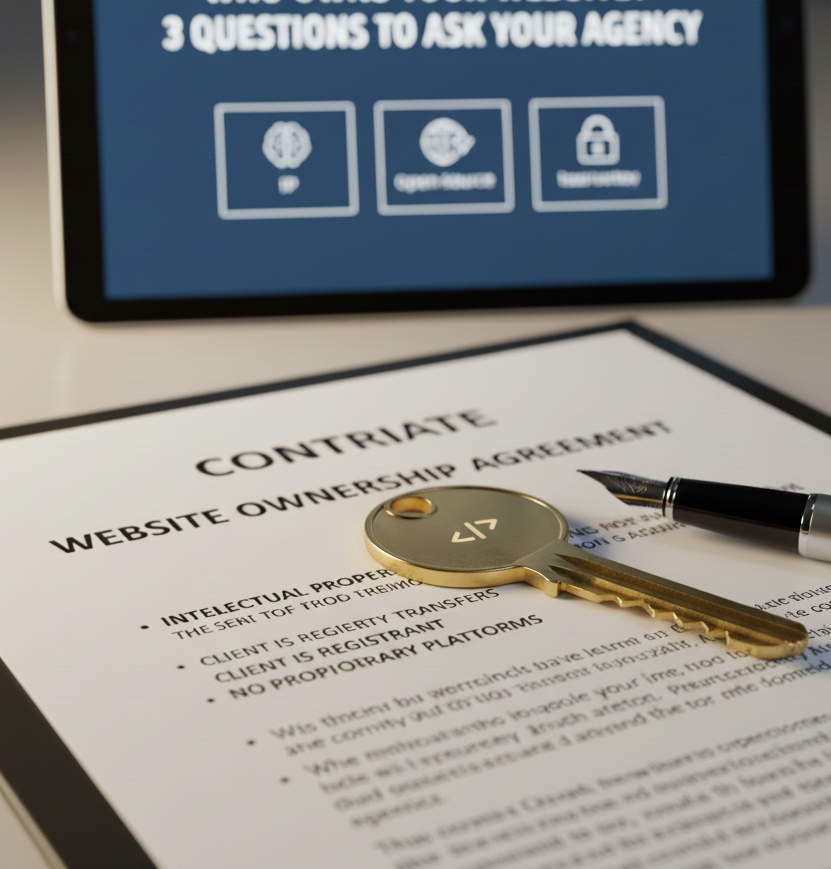
To address #4: Write: “Who Owns Your Website? 3 Questions to Ask Your Agency Before Signing a Contract.”
Would you like me to help you write a ‘Process’ page or a ‘Case Study’ template that specifically addresses these client fears?
Who Owns Your Website? 3 Questions to Ask Your Agency Before Signing a Contract.
This blog post is a “trust-builder.” It shows potential clients that you are honest and that you won’t “hold their website hostage”—a common fear in the industry.
Here is a structured blog post you can use for your agency.
Who Owns Your Website? 3 Questions to Ask Your Agency Before Signing a Contract
You’ve spent weeks interviewing agencies, looking at portfolios, and finally found the perfect team to build your new website. But before you sign on the dotted line, there is one critical question you need to answer: When the project is over, who actually owns the website?
In the world of web design, “ownership” isn’t always as simple as paying a bill. Many business owners discover too late that they are “leasing” their site rather than owning it. If they try to leave the agency, they find their site goes dark or they aren’t allowed to move it to a new host.
To protect your investment, ask these three questions before you sign any contract.
1. “Upon final payment, do I own the Intellectual Property (IP) of the design and code?”
In many jurisdictions, copyright law automatically grants ownership to the creator of a work (the agency), not the person who paid for it—unless the contract specifically states otherwise.
The Goal: You want a clause that says ownership of the “Finished Work” (HTML, CSS, graphics, and text) transfers to you once the final invoice is paid.
The Red Flag: If an agency says they “license” the design to you, it means they still own it, and you are just paying for permission to use it.
2. “Is the site built on a proprietary platform or an open-source one?”
Some agencies build websites on their own “in-house” software. While this might sound fancy, it creates a “walled garden.”
The Goal: Ensure your site is built on a platform like WordPress, Shopify, or Webflow (or a custom build where you own the source code). This ensures that if you ever want to switch agencies, any professional developer in the world can jump in and help you.
The Red Flag: If the agency says, “You can only host this site on our private servers,” you are essentially a tenant. If you leave them, you lose the website.
3. “Who owns the Domain Name and Hosting account?”
This is the most common way businesses get “locked in.” If the agency buys your domain (e.g., www.yourbusiness.com) under their name, they legally control your brand’s online identity.
The Goal: Your business should be the “Registrant” of the domain. You should have “Admin” access to the hosting and domain accounts from day one.
The Red Flag: The agency refuses to give you the login credentials for your domain or hosting, claiming it’s “for security reasons.”
The Bottom Line
A great agency-client relationship is built on transparency, not “hostage tactics.” At Finest Webs, we believe that if you pay for it, you should own it. Our contracts clearly state that once the project is complete, the keys are yours.